There is a version of this article that begins with chakras and auras. This is not that version. If you have arrived here as someone who finds the vocabulary of energy healing alienating — too mystical, too unverifiable, too far outside the framework of how you understand the body — then you are exactly the person this article is written for.
The goal is not to convince you of anything metaphysical. It is simply to translate a practice that is often described in esoteric terms into the language of measurable biology. You can decide what to make of it from there.
The Body as an Electromagnetic System
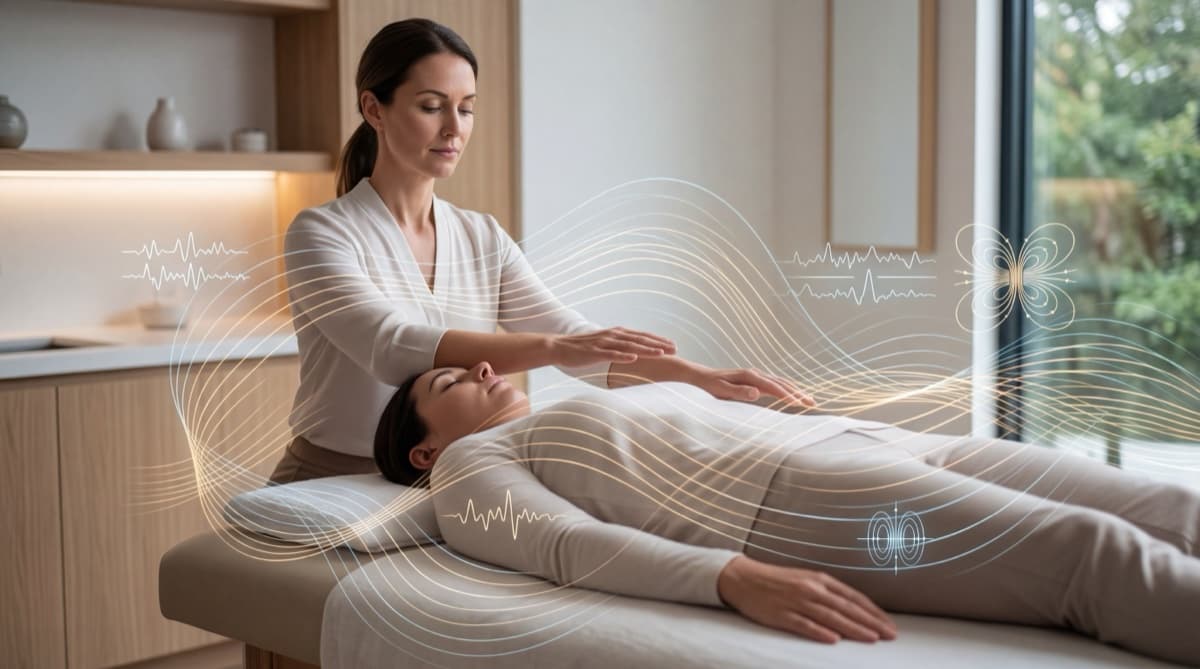
Here is a place to start: every organ in the human body generates a measurable electromagnetic field. This is not alternative theory — it is the basis of some of the most routine diagnostic tools in Western medicine. The electrocardiogram (ECG) measures the electromagnetic field produced by the heart. The electroencephalogram (EEG) measures the field produced by the brain. The heart's electromagnetic field, in fact, extends several feet outside the body and can be detected with sensitive instrumentation.
When biofield practitioners talk about "energy" in and around the body, they are — in their most scientifically-grounded interpretation — referencing these measurable bio-electromagnetic fields. The question that legitimate research is currently exploring is not whether these fields exist (they demonstrably do), but whether they can be influenced externally in ways that produce therapeutic benefit.
How the NIH Defines Biofield Therapy
The National Institutes of Health (NIH) classifies biofield therapies — including Reiki, Therapeutic Touch, and related practices — under the umbrella of "energy medicine" within its National Center for Complementary and Integrative Health (NCCIH). The NIH defines these as practices in which "the practitioner works with biofields, or the subtle energy fields that allegedly surround and permeate the human body."
The NIH is not endorsing the mystical interpretation. It is acknowledging that these fields exist and that their therapeutic application warrants serious scientific inquiry.
Multiple controlled studies have investigated Reiki specifically. A 2017 systematic review in the Journal of Evidence-Based Complementary and Alternative Medicine examined twelve randomised trials and found consistent evidence that Reiki reduces anxiety and pain more effectively than sham Reiki or control conditions. A 2018 study published in Alternative Therapies in Health and Medicine found that Reiki significantly improved wellbeing, sleep quality, and mood in healthy adults. These are not large-scale pharmaceutical trials, but they are rigorous enough to suggest an effect that warrants further investigation.
The "Kink in the Garden Hose" Model
Energy work practitioners often use the metaphor of a kink in a garden hose to describe what a "blockage" is: emotional stress, stored physical tension, or unprocessed experience that interrupts the body's natural flow. In neurobiological terms, this maps reasonably well onto the concept of chronic activation of the sympathetic nervous system — the body stuck in fight-or-flight mode long after the original stressor has passed.
Unresolved stress does not simply evaporate. It is held in the body — in heightened muscle tension, in the posture and breathing patterns the nervous system adopts as its new "normal," in the hormonal and neurological patterns that become habitual. The body-oriented therapies, of which Reiki is one, work at the interface of this physical holding and the nervous system response that maintains it.
What to Expect in a Session
A Reiki session with Megan at our Frisco studio typically lasts 60 minutes. You remain fully clothed on a massage table. She uses light touch — or in some cases, no-touch — techniques, moving through a series of hand positions over different areas of the body. There is no manipulation, no pressure, and nothing invasive.
What people report experiencing varies considerably. Some feel warmth or tingling in specific areas. Some fall into a state between waking and sleep — the Theta brainwave state described in our article on sound baths. Some experience emotional releases, often subtle, occasionally more pronounced. Some feel nothing in particular during the session and then notice, over the following 24 to 48 hours, that something has shifted: a long-standing tension is quieter, sleep is deeper, a previously looping thought pattern has lost some of its grip.
- Reduction in anxiety and stress response
- Improved sleep quality, often reported as the most significant early benefit
- Decreased chronic pain and muscle tension
- Greater emotional clarity and reduced mental fog
- A general sense of restored equilibrium
The Most Honest Thing We Can Tell You
Energy work should be positioned as what it is: a complementary modality that works alongside conventional medicine, not as a replacement for it. We do not claim that a session will cure a diagnosed condition. We do not make medical claims, and you should be cautious of any practitioner who does.
What we can say, based on both the existing research and Megan's decade of practice, is this: the body holds more than the mind consciously knows. And sometimes the most effective intervention is not another intellectual framework but a period of quiet, supported presence in which the body's own intelligence can do what it has always been trying to do.
If that sounds even remotely worth exploring, we invite you to book a session at our Frisco studio. Skepticism is welcome. You do not need to believe anything before you arrive.