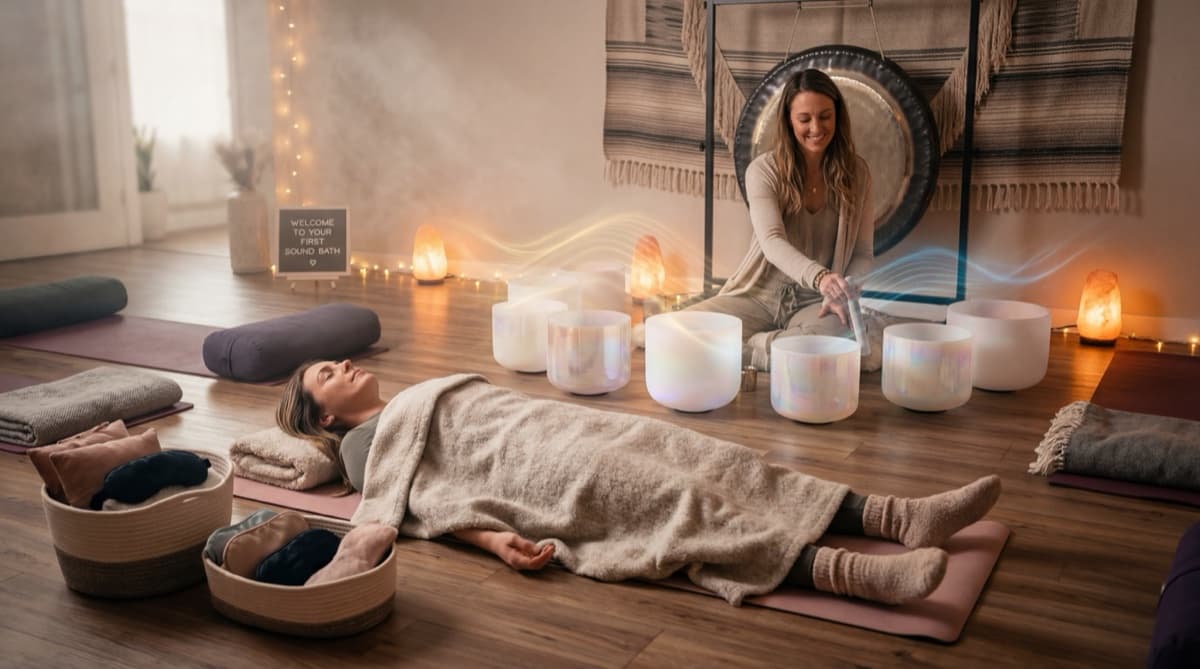
Let us address the most common question first: no, there is no water involved. Despite the name, a sound bath has nothing to do with bathing in the traditional sense. The "bath" is entirely acoustic — you are immersed in sound the way you might be immersed in warm water, surrounded on all sides, the sensation travelling through you rather than simply reaching your ears.
Think of it as an energetic deep-tissue massage in which you remain completely passive. There is no movement required, no breathwork, no meditation technique to master. The only instruction is to lie down and allow.
Before You Arrive
What to Wear
Comfort is the only consideration. Loose-fitting clothing — leggings, sweats, a soft long-sleeve — is ideal. One thing that surprises first-timers: your body temperature tends to drop during deep relaxation. Even on a warm day, bring warm socks, and consider a light layer you can pull over yourself during the session.
What to Bring
Our Frisco studio provides yoga mats and blankets for all sessions. If you have sensory preferences, you are welcome to bring your own pillow, an eye mask (many participants find this enhances the experience significantly), or a favourite blanket. Leave your phone in your bag or on silent — the vibration of a notification mid-session is genuinely disruptive to the acoustic environment.
What to Eat (and Not Eat)
Avoid a heavy meal in the two hours before a session. A sound bath in a deeply relaxed state is not the same experience as a sound bath on a full stomach. Light eating beforehand is fine. Arriving well-hydrated is helpful, as the body does a form of somatic processing during the session and hydration supports this.
During the Session
You will lie in Savasana — the yoga posture sometimes called "corpse pose," which simply means lying flat on your back with your arms slightly away from your sides and your palms facing upward. This is the position of complete surrender, and it is the best posture for receiving the full-body vibration of the instruments.
As the session begins, you will hear Megan begin to play. Drawing on over a decade of practice, she works with crystal alchemy singing bowls — hand-crafted from pure quartz crystal and tuned to specific frequencies — alongside gongs, chimes, and occasionally the human voice. The sound will seem to come from everywhere at once.
Many first-timers report that they did not fall asleep, but could not have told you exactly where they were. That threshold between waking and dreaming is precisely where the healing happens.
Common physical sensations during a sound bath include: warmth or tingling in the hands, feet, or chest; a sensation of the body becoming heavy or, conversely, of floating; gentle waves of emotion; and a gradual quieting of the internal monologue. Some participants fall into a light sleep. Others maintain a dreamy, deeply restful awareness throughout. Both are completely normal, and neither is more "correct" than the other.
After the Session
Allow yourself a few minutes at the end before you stand. The transition from Theta back to full waking consciousness takes a little time, and it is worth giving your nervous system the space to make that journey without rushing. We always build this integration time into our sessions.
Drink water. Eat something nourishing if it has been a few hours. Avoid intense stimulation — scrolling, loud environments, high-stress conversations — in the first hour after a session if you can. The nervous system is in an open, receptive state, and what you expose it to in that window matters.
The 48-Hour Effect
Many clients report that the full effects of a sound bath are not felt until the following day, or even the day after that. Deep sleep the night of a session is extremely common — often described as the most restorative sleep a person has had in months. A sustained sense of emotional lightness, mental clarity, and physical ease frequently follows.
This delayed and extended integration is one of the most interesting aspects of the modality. Unlike a massage, which tends to feel best immediately afterward, a sound bath often deepens in its effect over time. The body continues to process and integrate the experience long after you have left the studio.
A Note on Contraindications
- Epilepsy (particularly sound-induced): please consult your physician and notify our team before attending
- Pacemakers: the vibrations of gongs and large bowls can interfere; please let us know so we can adjust instrument placement
- Pregnancy (first and third trimesters): sitting further from the larger instruments is recommended; consult your doctor
- Recent surgery or acute inflammatory conditions: the deep relaxation response is generally beneficial, but notify your practitioner so adjustments can be made
For the vast majority of people, a sound bath is a deeply safe and deeply nourishing experience. If you have specific health concerns, we are always available to discuss them before you book.
We look forward to welcoming you into the space. The bowls are ready. All you have to do is arrive.