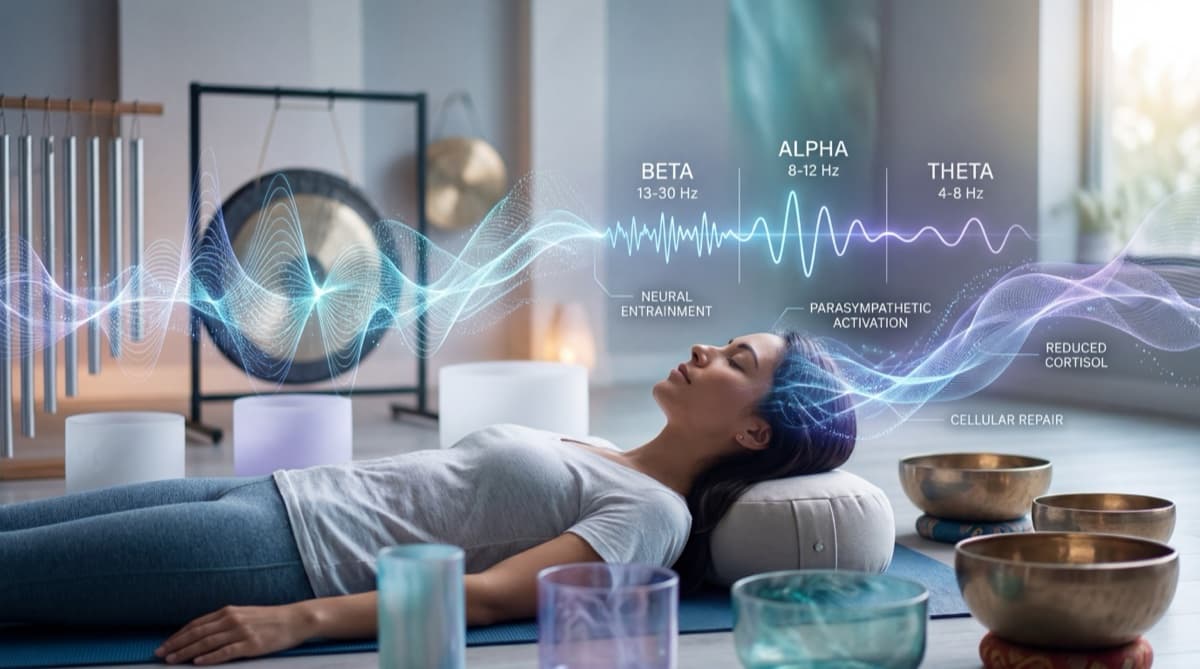
The concept of "sound healing" often sounds more like ancient mysticism than modern medicine. For those who have never experienced a sound bath, it is easy to dismiss it as ambient music dressed in spiritual language. But when you examine the actual physics of vibration and the neuroscience of brainwave entrainment, a different picture emerges — one grounded in measurable, reproducible physiological change.
The Brain You Walk In With
Most of us spend our waking hours in what neuroscientists call Beta wave states — electrical oscillations in the brain cycling between 13 and 30 Hz. Beta is the frequency of active thinking, problem-solving, and alertness. It is necessary, even essential, for navigating a demanding day. But a perpetual Beta state, which is the default for many high-performing professionals in North Dallas and Frisco, is the neurological signature of chronic stress and burnout.
The body was never designed to stay in high-alert mode indefinitely. When it does, the downstream effects are well-documented: elevated cortisol, disrupted sleep, suppressed immune function, and the persistent feeling that you are running on empty no matter how many hours you log.
The Physics of Entrainment
Sound baths work through a process called sympathetic resonance — or more specifically, neural entrainment. When a practitioner plays a Tibetan singing bowl or a crystal alchemy bowl, the instrument produces a sustained, consistent frequency. Because the human body is composed of approximately 70% water — a near-perfect medium for sound conduction — these vibrations travel through tissue at the cellular level, not just through the ears.
The brain does not simply hear the sound. It synchronises with it — a process as involuntary and precise as a clock resetting itself.
Research into binaural beats and acoustic entrainment shows that when the brain is exposed to consistent external frequencies, it will gradually synchronise its own electrical activity to match. A sound bath using instruments tuned to frequencies between 4 and 12 Hz creates the acoustic conditions for the brain to shift from Beta into Alpha (8–12 Hz) — the frequency of wakeful relaxation — and eventually into Theta (4–8 Hz), a deeply meditative state associated with emotional processing, creativity, and cellular repair.
What Happens in the Theta State
The Theta state is where the most significant physiological shifts occur. In this brainwave range, the body's parasympathetic nervous system takes precedence. The "fight-or-flight" response is deactivated. Heart rate and blood pressure lower. The brain begins releasing oxytocin and nitric oxide — chemicals critical for cardiovascular health, emotional bonding, and tissue repair.
Theta is also the state associated with hypnagogic imagery: the vivid, dream-like sensations that many sound bath participants describe as a "floating" feeling or heightened visual awareness with closed eyes. This is not hallucination — it is the brain operating in a mode most adults have not accessed since early childhood or the moments just before sleep.
Why Conventional Music Does Not Achieve the Same Result
A natural question: can you achieve the same result with a relaxing playlist? The answer, for most people, is no — and the reason is instructive. Conventional music, even calming ambient music, contains complex melodic and harmonic information that keeps the brain's analytical functions engaged. The mind tracks melody, anticipates harmonic resolution, and responds emotionally to lyrics or rhythm. These are all Beta wave activities.
Sound baths use sustained, non-melodic tones — the overtone-rich resonance of crystal bowls, gongs, and chimes. There is no melody to follow, no rhythm to anticipate. The brain has nothing to analyse. This is precisely what allows the analytical functions to quiet and the deeper wave states to emerge. For the high-performing professionals of North Dallas, this represents a rare and efficient path to the benefits of deep meditation — without years of dedicated practice.
What the Research Shows
Peer-reviewed studies on sound meditation have documented significant reductions in tension, anxiety, and depressed mood after a single session. A 2016 study published in the Journal of Evidence-Based Complementary and Alternative Medicine found that participants who attended a sound meditation session reported markedly lower levels of tension-anxiety, depression, anger-hostility, fatigue-inertia, and confusion compared to those who sat quietly in the same space without the sound stimulus.
Separate research has shown that Tibetan singing bowl meditation can lower systolic blood pressure and heart rate, with effects comparable to slow-breathing exercises used in clinical relaxation therapy. These are not anecdotal reports — they are measurable physiological outcomes.
A Note on Safety
Sound healing is a safe, non-invasive modality for the vast majority of people. However, there are specific contraindications to be aware of: those with sound-induced epilepsy should avoid immersive gong baths; individuals with pacemakers should notify their practitioner so instrument placement can be adjusted; and those in the first or third trimester of pregnancy are encouraged to sit further from the instruments and consult their physician beforehand. Sound sessions should always be understood as complementary to, not a replacement for, conventional medical care.
This isn't just relaxing music. It is a targeted, evidence-informed intervention for your nervous system.
If you are curious to experience the shift firsthand, we invite you to join Megan and the YES team in Frisco for an upcoming sound bath. No experience, no preparation, and no special beliefs are required — only the willingness to lie down and listen.